

When I was 12, my dad took me to a NY Rangers hockey game in Madison Square Garden.
We took a bus into the city and it was a real special night.
On the way home, there was some drunk idiot on the bus and he just kept on singing the following song:
I like beer…it makes me feel mellow.
I like beer…it makes me pee yellow.
After about 15 minutes, my dad had enough of it, got in his face, and told him to keep quiet. It was one of the only times I ever saw my dad angry.
Beer sure can make you do funny things.
Which brings us to today’s query:
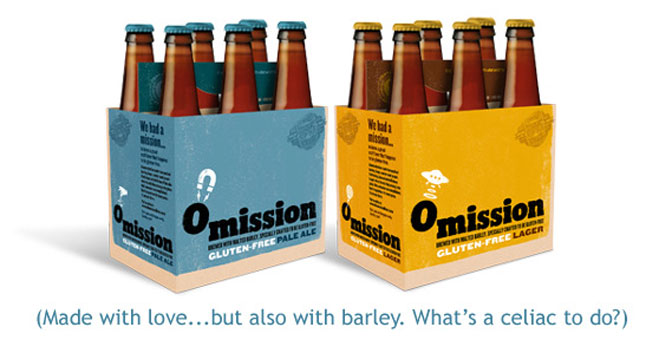
Should celiacs drink Omission Beer?
As I’ve stated before, I used to be a beer snob and it was a big loss when I was diagnosed with celiac disease.
The pickings were slim five years ago but lately, the gluten-free beer options have much improved.
When Omission Beer came out, I was totally stoked. I heard that it was one of the best on the market and I envisioned sitting by the pool, soaking up the sun and savoring the taste of a fine brew.
But then I heard it was made with barley and I got totally confused.
How can it be gluten-free if it’s made with barley?
Last week, Omission Beer reached out to me and asked me if I’d like a free sample. (Woo-hoo…FREE BEER!!)
Their email said that “everyone can enjoy Omission beer, regardless if they have Celiac disease or are gluten intolerant.”
Here was my response: I would love some samples as I’m a total beer snob. Here is my dilemma though. Omission is very straight up that the beer contains some gluten, but less than the 20ppm. Do other gfree beers also contain gluten but are just not open about it?
And they came back with this: You are correct that we are very transparent of our brewing process and the gluten content in the beer. We are the only U.S. beer brand making beers for the gluten intolerant using barley.
I was still confused so I did some more research.
I found the following on their website FAQ:
Is Omission beer gluten free?
Omission beer is brewed with malted barley, but we’ve developed a proprietary process to remove the gluten to ensure that gluten levels in every batch measure well below the widely accepted international gluten-free standard of 20 parts per million (ppm) for food and beverages. According to federal guidelines, we aren’t legally allowed to claim that Omission beer is gluten-free outside of Oregon because the beer is brewed with malted barley. While the FDA proposed to define the term “gluten-free,” that definition has not been formally adopted by the organization. While Omission beer does contain barley, one of the “prohibited grains” in this definition, all batches are tested by an independent lab using the R5 Competitive ELISA to ensure that gluten levels meet our standards.
God…our labeling laws just suck.
To me…gluten-free should mean gluten-free. And if it’s not gluten-free, how can it be safe for celiacs?
Is 20ppm really ok for celiacs to tolerate? I still haven’t seen a definitive study on this.
I don’t blame the good folks at Omission beer. They are being extremely open and honest about their beer. And I truly, truly appreciate that.
And there is a good chance that if I drank it, I’d be totally fine.
Well…I’d have a nice buzz, but I’d be fine celiac-wise. You know what I mean 🙂
But I’m not going to drink it unless somebody can prove to me otherwise that I should.
So Omission Beer in a way is being punished for being transparent.
What do you folks think? Have you tried it? If so, how did you feel. If not, would you drink it?



I worry that it would make me sick too. Thing is, I’ve heard of people testing even regular, gluten-full beer (like Bud Light) with at-home tests and they have come back less than 20 ppm, and I PROMISE I would get sick from drinking one. I think that the fermentation process might alter the accuracy of those testing kits. The testing Omission uses might be more sophisticated – I don’t know. But same goes with a recent article I saw about regular ol’ soy sauce being less than 20 ppm and testing fine – it’s fermented, so I think that makes a difference. Either way, I know both regular beer and soy sauce would make me sicker than a dog. (early gluten-free living mistakes can really teach some lessons!) So I’d be curious how/if someone can prove that this will be okay to drink. For now, I’m steering clear. As much as I miss “real” beer, it’s not worth it.
I couldn’t believe that people actually believed (and then convinced others) that Bud Light was safe to drink.
Until I was at a Christmas party and an old friend who has a celiac husband was telling me that her husband tried it one night. I was just floored by that.
Somebody recently told me that Corona was gluten free. I don’t know…I guess people believe what they want to believe. Or they’re in denial.
I heard corona is considered gf because of the 20 ppm thing-in the UK
Try Ground Breaker from Oregon make for chestnuts and sorghum
I got sick from Estrella which boasts the same process…
I have celiac, had a glass of Omission and seemed to be ok.
Me too. It did not make me sick in the slightest bit.
I drink Redbridge (made by Budweiser) and Omission and both seem okay for me.
Red Bridge uses sorghum instead of wheat/barley so it’s gluten free. Still takes like skunked Budweiser. Omission removes gluten in fermenting process similar to Jameson Whiskey so it maintains original flavor. Best bear that is brewed to remove gluten is Two Brothers brewery who removes gluten in their Prairie Path Ale. Best tasting and I’ve had plenty without problems
According to the French speaking Swiss celiac association the elisa test is not totally reliable because some of the protein molecules are fragmented and will not be detected by the test.
We just launched SpikedSeltzer, a 100% gluten free, low carb alcoholic beverage with 6% ABV. It’s flavored with whole crushed limes, and tastes like… lime seltzer, with no bitterness or aftertaste you would get with vodka or hard spirits. We’ll be in WholeFoods in CT and FL, but we’re expanding due to the demand. Visit us at http://www.SpikedSeltzer.com, or send an email — it’s easier to get carried in retailers if we can show local demand!
I would definitely try your product, GF and taste good, don’t seem to go hand in hand. We will see.
Sharla –
Thanks for emailing! I think you’ll be happy — although this tastes like seltzer / sparkling water, NOT beer beer… but it is 100% COMPLETELY GF. Where do you live? We’re distributed in the Northeast and Florida — but we’d be able to send some samples!
DH
founder
SpikedSeltzer / Boathouse Beverage
http://www.spikedsetlzer.com
Silly me. Was told it was gluten free… Longed for a decent beer after 8 years of none… Wishful thinking and the 49s playoff game made me a little cavalier… OMission lager was sooo freakin delicious! Resulted in a painful lesson. Day 4 -still healing. Gluten, even in minuscule amounts is poison to Celiacs.
I took a chance last night at a favorite hangout of ours and tried this beer. Bartenders and waiter recommended it and of course, called it “Gluten-free.” After much hesitation, I drank it and thought to myself, “Wow, this is too good to be true.” Guess it was! I’ve had Celiac Dz for 6 years now and also have a craved a ‘real’ beer again! Generalized swelling today in face, arms, legs, stomach. So no more for me!!
This beer is NOT ok for anyone who is gluten intolerant. My husband tried it and it caused a reaction for him. The “acceptable” levels are a bogus indicator. Gluten-free labelling needs to be standardized! Barley is not tolerated at any level for those that have been diagnosed for 30+ years as the body gets increasingly sensitive.
I have Celiac disease. I drank Omission. It is not GF as far as my body is concerned. Maybe Gluten intolerants can drink it, but I cannot.
Vivian, I am so sorry you had a bad reaction. It is really important that every celiac who has a bad experience reports it to the FDA, TTB, and the Celiac Sprue Association (CSA). When I filed my report I was told they had not heard of people having problems. I know this is a hassle for us with are already busy lives due to the gluten free requirement, but this has implications for future gluten free rules. Please contact them.
FDA: 240-402-2405
TTB: jeffrey.salisbury@ttb.gov
CSA: celiacs@csaceliacs.org
Omission is disgusting tasting. Sour, bitter….you are not missing a thing!
I have found that the Pale Ale tastes like an IPA, but their other beers are really bad.
I wouldn’t, because I know I react to that “less than 20ppm” guideline. I maintain that you have to KNOW YOURSELF better than anyone, regardless if anyone tells you it’s “safe because…..”
Yep…agreed. I really do hate the whole 20ppm thing. Free should be free.
GFDUDE –
Agreed to your agreement — 20ppm is entirely arbitrary. When does “Free” mean “some”? Never.
SpikedSeltzer is 100% GF. It’s 6% ABV, 5g of Sugar, and All naturally flavored with cold pressed citrus (and now white cranberry) . I’d love to send you a sample or two!
DH
Do you drink vodka? I have Celiac and only eat and drink things that are 100% gluten free, however, I do drink vodka. I have been told that it is so far altered it doesn’t have any gluten in it, and I have never had a problem with it. This seems like the same issue though, and now I’m wondering whether I should back off the vodka.
Anya – (love your name by the way. I wanted to name my ‘daughter’ that, but she turned out to be a boy!!! surprise!)
The vodka you’re drinking is probably fine as I believe much of it is made from potatoes. At least, that’s what my bar-owning friends told me. However, I have to stay away from the flavored vodkas as there is a good chance that they have malt in them. I like to flavor the plain vodka with skittles and mix it with sprite. YUM!
HNY!
Did you say stay away from vodka????? 🙂
Many vodkas are made from wheat but yes, the distillation process is supposed to pull out ALL of the wheat I thought. We seriously need an easy at home test.
I drink Tito’s Handmade Vodka…its made from potatoes and in made in Austin (where I live). It even says gluten free on it.
Tito’s!!
I bought a very expensive 6 pack of omission and the first sip made me sick. It tastes good but I had to give the rest away to my friends who don’t have gluten issues. I would venture to say that my body is far more sensitive than any elisa or other test and 20 ppm is too much for me to tolerate. For that reason I will not try corona or hineken and will stick with redbridge until I brew my own.
Titos is made with 100% corn.
Folks: Sensitivity to gluten ranges. I am hyper sensitive. So, here is why 20 ppm will not work for me (as in wheat-dervied vinegar and wheat derived vodka). If it works for you, that’s great. The problem is in the solution (double entrende, bartender!): 20 ppm is 20 mgs per liter which after estimated molecular weight and molarity calculations and drinking only 20 milliliters, (1/10 of a pint), that still leaves your gut receiving 5.28X10^15 molecules. That’s only 5.25 quadrillion molecules total. If your system does not react to that, not to worry, however, you could be increasing your sensitivity unwittingly; beware: the immune system has a great surveillance system in place and increases vigilance with increased sensitization (exposure).
Tito’s is made from corn. It is very smooth and delicious. I also like Chopin & Luksusowa vodkas, which are both made from potatoes. I stay away from alcohols made from gluten containing grains even though the distillation process is supposed to remove the gluten. For me, I’d rather be safe than sorry.
its made with corn
Thank you!
Most Vodkas are actually grain based I believe dear so do be very leery and do make sure your server always knows of any intolerance because some distilleries offer 1 based in Rye, 1 in Corn, & another in Barley and a mix up is never a good thing!!!! Several distilleries are producing spirits however with only Corn or Grapes as well as a few really outside of the box fashions …. There are really fantastic and noteworthy products from these varieties!!!!
My partner went out of his way one evening and went through the collections at 3 different liquor stores to find a completely grain free vodka. He found a brand that is pure potato, and it tastes pretty good in Caesars.
There are some excellent vodkas made from potatoes and grapes. What was the brand your partner found?
I’d like to hear what one you found too, Pixie!
I tried Luksusowa from Poland.
It was okay, but the one that many say is good
is Chopin or even better, I guess is one from Austria called Monopolowa.
Cirac is supposed to be exceptional. And for the price they are charging, it better be!!
It’s the Luksusowa stuff.
It’s not very good mixed into anything but clamato/tomato juice, it’s got a strong and interesting flavour, but it get’s the job done haha. I find when I make caesars, the potato-ey taste mixes right in and you can hardly taste the alcohol. Made for a very interesting New Years hahaha!
If you ever make it out to the Midwest, 45th Parallel (sold mostly in Wisconsin) is only made from corn and its the best vodka I’ve ever had. They also just released their first bourbon and whiskey and also found them to be gluten free (no added gluten in later mashes means the distillation process is pure and removes any gluten present).
Cirac’s pretty damn good, though.
In terms of your other question, I might try the Omission beer once. I am a mostly non-beer drinker, though, so its likely I might have one a year (I’m probably not their ideal customer LOL). It’s like any of the gf processed foods – a few in moderation ain’t bad, but I’m certainly not going to go out and drink a six pack and have some frozen gf pizza in the same night…
I tend to drink a lot of Mike’s hard lemonade. Never had an issue with it.
There are gluten free Vodka’s available… Check out Tito’s! Made from corn and is labeled gluten free!
Anya, My understanding is that the distilling process eliminates ALL gluten. So, it is safe to drink vodka or any other distilled beverage. Even whiskey. Bottoms up!
Kathleen, I cannot drink vodka that is derived from Barley or other wheat products. Tito’s or potato vodka, Ciroc are the only ones that are safe for me. Had 2 vodka sodas made with Belvedere and had a headache, itchy, nauseous well into the next day.
Kate, I’m really sorry you had a reaction. I have not had a reaction to vodka and I am really sensitive to gluten. Perhaps you have an allergic reaction. It really is awful to get “glutened” I am so sorry you had that experience.
I guess it just depends on the individual. I’m relatively new to gf eating and drinking, and have heard people have mixed reactions to grain alcohol. Tried my first sip of whiskey since being diagnosed, and I’ll definitely never do that again. So I would guess that grain vodkas wouldn’t work for me either. Also, as a former beer snob I was excited to try omission, and didn’t hesitate to down a bottle. I had a small reaction, I didn’t get horribly sick but I won’t be running back to the bar for another round. So drink at your own risk I guess.
I love potato vodka and frequently drink Luksusova, a Polish potato vodka. Grain vodkas ARE safe, however, as distillation process brings over alcohol, but not heavy proteins like gluten. Unless glutinous substances are added back for flavor, ( I suspect bourbons here), You are safe. I drink potato vodka not because I am gfree, but because I love the smoothness of a potato vodka! On the other hand, beer is NOT distilled. So what is in the vat gets in you. I would be interested to know how these “proprietary” measures to get the gluten out of a barley based beervwork!
I talked to the people at Omission and they said that every batch has come in under 10ppm, and you can even test your bottle on their website: http://omissionbeer.com/test-results/omission-lager-12-4-12/
I drink it frequently and love it!
Here’s my concern. Even if it doesn’t make me feel ill, it doesn’t mean it’s not doing harm to my celiac body. There is just no conclusive proof in my eyes that “a little gluten” is ok.
Am I being paranoid?
“I’m only paranoid because everyone’s against me.”
– Frank Burns, M*A*S*H
I got that one, Dude 😉
So, I am just tonight trying Omission and this is the first GF beer I have had in over a year (diagnosed Celiac) that tastes more like beer! I do not think that I am as sensitive as others, but if I sat down with a Coors Lite (which I miss terribly) I woul feel sick in minutes after a few sips. My gastroenterologist explained that once you go gluten free for a while, your body might tolerate small amounts of gluten. As long as it is not on a regular basis, even choosing to cheat a little would not be that harmful. Again, I understand that everyone is different. For me, I can have these at a BBQ and feel like everyone else grabbing an icy cold one out of the cooler. I am not a cider fan and yet keep trying them!
Ok, so I read that a lot of these people who tried Omission reported illness. Also, many individuals wrote that even if you do not feel the effects from Gluten that does not mean it is not causing celiacs to have compromised immune systems. So, I take back what I said previously. Looks like no Omission for me.
Kelly, Looks like we posted simultaneously!!
🙂
I was just telling you this same thing.
Honestly, I am stunned a GI doc would say such a thing. wow.
My gastro doc was angry when he learned a GI doc told a celiac support group it was “okay to cheat”.
We really do not become more tolerant of gluten after a while. I have never read that statement in any medical lit.
And I do not know any celiac who hasn’t suffered from a small hit from cross contamination. (man, that would be so great if it did not happen) 🙂
The effect is less, maybe, but it still happens.
And even if you do not “feel it”. you restart the inflammatory response.
But I am glad you liked the Omission! 🙂 🙂 My hubs thought it was really good.
I wasn’t into hard ciders very much either until I discovered hopped ciders. Woodchuck Hopsation is my favorite; Angry Orchard makes one too. The bitterness of the hops mitigates the sweetness of the cider and, to me, makes these more drinkable. Oddly, I wss never a fan of heavily hopped beers, preferring the dark, malty ones. I like regular hard cider, but generally only want 1 because of the sweetness. The English and Irish ciders are usually drier than American ciders which I find too sweet. I’ve always liked Magners (Irish) which can be found on tap!
I do not drink Omission either. I do not think you are just being paranoid. I have a very low threshold. I tried omission and I got sick.
I drink Omission IPA every day and have no problems whatsoever, but one Daura Damm from Estrella and I’m sick, so it may be that Omission’s hyper-strict brewing is paying off for some of us.
Like you I do like my beer and was thrilled with the newer offerings made with barley but brewed to be gluten free. I am very sensitive to gluten along with many other carbohydrates, as many other celiacs are. However I very happily drank these more “real” beers. Since the new TTB labeling rules and the information about the validity of the testing came out I am much more hesitant to consume these beers. I did try Omission in NYC a couple of months ago but I believe we need to be much more cautious about what we allow to be considered to be gluten free. I still have a case of Daura and left the Omission with friends in NY. Rare consumption may be okay but for the regular consumer I would never suggest these items be a part of a celiacs diet.
Glad we are in the era of looking for different options for people who have sensitivities and better testing methods to confirm the status of products.
Perhaps we’re getting there Sophia. Perhaps.
My wife only drinks Red Bridge gluten free beer. It’s made from sorghum and tastes like regular beer.
I tried Redbridge, and nearly spat it right out. It tasted very metallic and harsh to me, nothing like a real, good beer at all. I thought it was just nasty. I didn’t drink more than 3 sips, then tossed the rest. But that was just my impression. Then again, I’ve never liked anything by A-B.
I tried Bard’s and loved it! It’s made with malted sorghum. Apparently it’s the only GF beer that is malted – which an extra step. I wouldn’t be comfortable with Omission. I really enjoyed Bard’s myself.
Another option along the same lines of a “Gluten Free” barley beer is Prairie Path, by Two Brothers. You can see their info about the gluten content here (less than 5 ppm): http://www.twobrosbrew.com/gluten.htm
I have celiac disease and am very sensitive. I have to be incredibly careful about cross-contamination–recently my whole household went gluten free because of repeated accidental ingestion of gluten (going on 4 weeks now without being glutened!). I drink Prairie Path with no problems whatsoever.
Of course everyone has varying responses, and as Kathy said, you have to know yourself, but thought I’d share.
I won’t drink it for the same reasons I look for ‘certified gluten free’ products or products manufactured in a ‘dedicated gluten-free facility’
It’s not worth it. I’ve gotten sick too many times from “gluten-free” products (our labeling standards suck!). I tried the Omission beer line at a gluten-free expo and it was alright. It’s nothing that would please a beer connoisseur such as yourself. We recently purchased a homebrewing kit and the homebrew store had over 30 gluten-free beer recipes. So, we’re going to start making our own gluten-free beer as I’m SICK of cider and don’t want to risk being sick from 20ppm. Who’s the beer snob now?! 😉
Let me know how your home brew turns out. I could totally be talked into that.
Awesome!!! I have really thought seriously about this. I don’t trust any one with my health. If I screw with my health, that is one thing, but let someone else do it? no. Homebrew. Yumm
Isn’t Daura made with barley as well? Are both companies using the same science? What is this science anyways?
I’m usually very curious about beers in general because I’ve never had a gluten one… I usually take a sip then pass it to my boyfriend and go “DOES IT TASTE REAL!?!?!” usually I get a “uhhh not really..”
So I would probably wait and research how other people who have tried Omission react to it and if I decide it doesn’t sound so bad then I will try a sip.
I think Daura is made the same way. Hopefully, we’ll get one of their reps to chime in here.
I have Celiac’s and have tried both Omission and Prairie Path. Dude, like you I was a lover of beer. Especially craft beer. Omission made me sick, Prairie Path did not. I believe they use a similar process, so I am not sure why one was fine and the other was not. I struggle with drinking it though, because I know I am still putting something in my body I shouldn’t (the barley, not the beer).
Interesting. I too wonder what the difference is between the two.
Celiac with hypoglycemia is really a pain in the ***
Which Omission beer did you try? I tried both and they both seem ok. I do feel something when I drink them but not serious, so I can still drink three bottles with no problems but if I’m gonna continue I would drink something else. I still prefer to drink sourgum based beer.
Don’t do it Dude. It’s a bad idea.
Random movie quote:
“Andy: You guys, she’s picking me up in a hour.
David: Oh, drag, dude.
Cal: She’s picking you up from here?
Andy: Yeah.
Cal: That’s fucked up, man.
Andy: Why?
Cal: Why?! Seriously! I mean, look at this place, man. You gotta see this through the eyes of a woman, you know? What is she going to think when she comes in here? “Look! He’s got a billion toys!”
Andy: So what?
Cal: And more video games than a teenage Asian kid.
Andy: Okay.
Cal: [Pointing to an action figure on a shelf] Is that the Six Million Dollar Man’s Boss?
Andy: That’s Oscar Goldman.
Cal: Why do you have that?
Andy: That’s worth a lot of money. That’s much more valuable than Steve Austin.
Cal: Well, that may be the case, but none of this shit is sexy, okay?
Andy: I’m not trying to be sexy, man.
Cal: [Pointing to a framed poster] I mean, seriously, Asia? You framed an Asia poster? How hard did the people at the frame store laugh when you brought this in?
Andy: They did not laugh at me.
David: Know why you’re gay? Because you like Asia.
Andy: You guys, cool it with the gay! You know, she on her way here, okay?
Cal: First, you relax, okay?
Andy: Just stop calming me down and tell me what I should do.
Cal: Okay, we just take everything that’s embarrassing and we move it out of here so it doesn’t look like you live in Neverland Ranch.”
-40 Year Old Virgin
Cheers,
Jersey Girl
You rock Jersey. Haven’t seen it yet.
I have only tried Estella Damm Daura. It’s allowed in the UK, because it’s tested to under 8ppm gluten, and the limit in Europe is 20ppm. It does not make me ill. Apparently it’s difficult to test below this level, as if you try to increase the sensitivity much further you end up detecting gluten in every food imaginable.
If you think I’m poisoning myself and not knowing it, I am VERY sensitive to gluten – half a teaspoon of butter from the wrong tub – and no crumbs in sight – was enough to make me unwell for a week. So I think a whole bottle of beer would have made me ill if there was any gluten there.
If you look through Coeliac UK’s facebook page you will find lots of people who can tolerate things made out of gluten-containing grains that are especially processed to be gluten free, and as many posts from those who cannot tolerate these. Codex wheat, barley malt extract, gluten-free oats. Everyone’s different, I think it depends on your sensitivity to other parts of the grain.
So, it might be worth a go if you are missing the beer, but maybe start of with one bottle in case it doesn’t work out for you.
“if you try to increase the sensitivity much further you end up detecting gluten in every food imaginable.”
That’s kinda scary…
Apparently they have “detected” gluten in plain, uncontaminated rice and we know we can eat this.
I have been eating bread made with codex wheat starch for all but a short time after I was diagnosed;, my doctors are happy that my gut is healing/healed. And although I am great with gluten-free oats and Estrella Damm Daura beer, the same cannot be said for barley malt extract, so I avoid the ingredient even if the product is listed in the gluten-free directory.
And, of course, my diet is not composed entirely of codex wheat starch. It’s 4 small (tiny) slices of bread a day, tops. Very often, I don’t have bread at all, it just depends. I eat lots of home cooked food, fresh fruit and vegetables, potatoes and rice, plain meat, eggs, cheese and fish. So I would say fairly confidently that my overall diet is well below 20ppm. The 20ppm (to be classified as gluten free) is a limit not a target!
As I said, everyone is different, you need to listen to your own gut.
A link to Coeliac UK’s information on to 20ppm limit is here:
http://www.coeliac.org.uk/gluten-free-diet-lifestyle/choosing-safe-foods/is-there-a-safe-level-of-gluten
I had omission once. It tasted good but made me sick….never again!
Thank goodness I’m not the only one!
Same here! Whenever I drink alcohol that has trace amounts of gluten in it (including most brands of hard liquor), I get extra buzzy and headachy. The next day my stomach is a little off, mood a little off. It’s not a full fledged gluten reaction, but I know I got exposed. If I drank Omission multiple nights in a row (or just got plain wasted on it), it’d get worse.
Most brands of hard liquor have trace gluten in them?
Can you post those for us, so we’ll know which ones you mean?
Thanks.
If you have ever eaten products with a GF label, you are potentially eating trace amounts of gluten. Some can only test to down to levels of 5 PPM. Many companies use the 20 PPM threshold because it has been studied in clinical trials with real live celiacs (who volunteered for that–yikes!) as being “safe”.
There is no “zero gluten” test.
So, in essence, you are potentially consuming extremely low levels of gluten. But it does not mean it is messing with your villi.
Dr. Alessio Fasano wrote:
“At the University of Maryland Center for Celiac Research, we support the use of evidence-based research to
establish a safety level for ppms of gluten.
Limits must be established through double-blind, randomized trials
such as the one conducted by our center in 2007.
The three-month trial showed that a daily intake of 10 mg of
gluten (that, translated in ppms, would be equivalent to the daily ingestion of more than a pound of gluten free
products containing 20 ppm of gluten!)
for three months by adults with celiac disease caused no intestinal
damage.
However, the threshold of 50 mg was harmful to the majority of patients.”
(Visit http://bit.ly/qG12X3 for safe daily levels of gluten consumption.)
Dr. Fasano wrote in defense of establishing 20 ppm as the safety threshold for celiac disease patients for FDA labeling. It still has not happened yet, but it is actually in our favor as it will set some regulatory standards for us.
http://medschool.umaryland.edu/celiac/documents/FDA_labeling_letter.pdf
Under 20 ppm should not cause villous or intestinal damage, but it does not mean you will feel okay eating or drinking it.
DEDICATED facilities afford you the best options for safety.
Beers NOT containing barley (no matter the level) are probably wiser.
Brewing your own beer is even better (we do it for the hubs– but I have 1 every so often )
but if I were a regular beer drinker? I’d stay away from this beer.
IMHO
There are two things that bother me. First, the studies that show that tests to detect specifically barley gluten are not accurate. This means there could be far more gluten in it than they are able to actually detect. If I could find links to those right now I would, but either someone will be along with them shortly or I’ll find them over the weekend.
Second, we are taught immediately that no amount of gluten, no matter how small, is ever okay. Why the fuck would we intentionally eat/drink something with gluten in it, regardless of how little is in it?!?! This below 20 ppm thing drives me up a fuckin wall! It takes a lot to blow me out of all my senses this badly, but holy crap people. NONE IS EVER OKAY! NONE!
Okay, I’m done being crazy. Seriously though, at what point do we go from we can not have any gluten, ever, under any circumstances, no matter what, period… to, maybe a little beer or a bread made from “special wheat” or something is okay sometimes? We’re begging for trouble when we do that. You’re right, we don’t have to get sick to be screwing ourselves over. Until someone can tell me with 100% accuracy and the verifiable research to back it up that there is no risk that this will be the time that I give myself cancer, or a celiac crisis, or a new AI, until I know that I won’t be breaking the camel’s back… I’ll skip the straw so to speak.
Then again, I don’t drink any more. So take my opinion as you will, and next time you indulge, feel free to have my share.
Great post Adalaide…I like when you’re crazy 🙂
I’m with you. I know there are many celiacs out there who want to believe that a little gluten is ok. It saddens me.
Personally, I won’t be satisfied until they tell stop telling us that 20ppm is ok.
This is probably an ignorant question, but I’m going to ask anyway.
If something contains a”safe” amounts of gluten, but you exceed the serving size or combine different foods/drinks all containing “safe” amounts (but still traces of it), wouldn’t you ultimately be “glutening” yourself and exceeding the “safe” limits with the combination since the amounts would add up?
I rarely eat a recommended serving size of anything (box of crackers anyone?) and can’t remember drinking only one beer. I can also see eating many different things containing “trace” amounts over the course of a meal or a day that together would add up to well over 20ppm..
For me, I would rather what I ingest be totally gluten-free. I am a bit paranoid that any level of gluten other than 0 ppm is “safe”.
From what I understand, your assumption is correct. If the only food you ate all contained 20ppm gluten, you would reach the daily “safe” limit for gluten at 500g (454g = 1 pound) of food.
On the other hand, many “de-glutened” foods should fall well below this limit (but it’s hard to demonstrate); and unless you are under the impression that a normal healthy diet consists of dry bread made from codex wheat starch, washed down with de-glutened barley beer, you’d have to be going it a bit to get to that sort of quantity anyway
My understanding is that a normal healthy diet includes a mixture of foods, and many raw ingredients are gluten-free (fruit, vegetables, meat, fish eggs, potatoes and rice for extra energy). We only “need” the substitutes for practical reasons (e.g. no cooking facilities at work etc.) or for social reasons (everyone else is drinking this or eating that, and you want to fit in with the crowd).
I think if you can eat foods that are naturally gluten-free, and just a few substitutes/de-glutened items as required you can probably eat more healthily (and cheaply) than if you are heavily reliant on them.
And, regardless of what it says on the label, and regardless of official advice from doctors, researchers etc., if you feel ill after having something, don’t have it again. Even if the gluten isn’t upsetting your system, something else in there might be. And your gut is what is important to you.
I was told that if I only had a few beer the gluten wouldn’t bother me. This persons friend has Celiac and does it all the time and is fine. I was floored.
Tell this person:
If you have celiac and you drink gluten- filled beer on a regular basis, you’re not fine.
You’re stupid.
Just because you have no immediate symptoms, you still spark the autoimmune response and invite further AI diseases, illness and complications.
What part of “the only treatment for celiac is a gluten free diet” do people not get?
Choosing to screw around with this diagnosis is careless–but hey, we’re all grown- ups, right?
I hate hearing this Pixie. I’ve been told things like “my friend’s celiac must not be as bad as yours, because she cheats all the time.” Argh!!
I hate it when a restaurant says things like “you must be REALLY sensitive”. I’d like to counter with I bet many restaurants don’t take my illness seriously enough, and therefore, maybe I’ve had the bad luck of being blatantly glutened by someone deciding it isn’t that big of a deal. I’m not sure that any of us have had the pleasure of being fed regimented amounts of gluten that would allow us to determine our ‘sensitivity’. At this point, all I know is that some days I get sick. The reaction is delayed just enough and the symptoms are just vague enough that I can’t swear it was a specific item. I just know, that when I am less careful… the following week I have less energy and flush more and get malaise in the evenings.
That is the worst!! I was at a local restaurant and having a Bloody Mary with a friend, when a lady sat down next to us and started asking about the ingredients in their drink. The bartender looked lost *not a shock* but since I’ve been there multiple times I knew that for a fact they had a gluten free Bloody Mary. (I actually had them get out all of the ingredients the first time and made sure it was, thankfully the owner is awesome) I assured her that it was gluten free. We talked for a little about how gluten free things or people understanding is hard to come by *welcome to North Dakota*. Anyway, she ordered her drink and when the bartender asked if she wanted a beer chaser she ordered a corona. Nothing bothers me more then people doing things like this because it gives some people who really want to be sure that what they are consuming won’t in the end hurt them a bad name and looked at weird when asking questions! She asked if I ever tried to drink different beers containing gluten then, me, being a smart a**, responded with “nah, I don’t really like it when my body attacks itself and can make me malnourished.” Needless to say, she didn’t say another word to me for the rest of her duration at the restaurant.
Miss Dee says what we all think:
“For me, I would rather what I ingest be totally gluten-free. I am a bit paranoid that any level of gluten other than 0 ppm is “safe”.”
Well, I agree with you 100% (except for the paranoid part) 🙂
This is why the focus of our diet should be on naturally, inherently gluten free foods and less on the packaged stuff.
Guys,
Someone very wise said to me once:
“the Earth is a shared facility”.
Gluten is used in many products and food items in our world, yes.
So?
Do not INTENTIONALLY consume it.
Avoid it as best you know how.
The under 20 PPMs as being a “safe level”– is just a guideline, based on clinical studies of celiacs who have no villous atrophy
when exposed to that amount.
Think what you wish about that data.
Paranoia serves no purpose except to make us all nut jobs.
🙂
Perfect advice Irish!
Great…. Earth is a shared facility.
You KNOW I come here right?
I am the single most paranoid person I know. I am already so far beyond nut job that I’m not sure what I am any more. Seriously. I am scared, like borderline panic attacks scared, of toddlers. I’m such a freak. But I’m a fun freak.
oh, you’re all that, lady! 🙂
. and…Happy Birthday, sillypants.
I was just wondering – Isn’t the main study that determined the “20ppm” the Fassano study which only evaluate 39 people, one of which developed symptoms on the 10 mg dose and dropped out? Are there others? If not, while it is an appropriate start, I don’t feel comfortable that it could be guaranteed to capture a true safe threshold.
There’s a chart floating around somewhere on the internet that shows the results of gluten tests for beers. Corona and a couple of other “regular” beers came in at 5 ppm or less. On that basis, and on the basis of other celiacs who said they’d tried it with no ill effects, I tried Corona…it didn’t give me my regular gluten reaction, but I felt really weird in different ways for about three days. Scientific chart or no, I’m never going to try a “regular” beer again, even if other folks say it’s okay for me.
Daura, however, was fine for me, but it’s not sold in my state so I don’t really drink it. I’ve seen Omission in my liquor store but I hesitate every time for the reasons everyone’s talked about here. It’s just not worth the risk.
I’ve seen some studies that show that the gluten test is easily fouled up…better to eat natural foods (fresh fruits, veggies, etc.) and things produced in a dedicated gf facility…
“better to eat natural foods (fresh fruits, veggies, etc.) and things produced in a dedicated gf facility”
[nodding my head]
As I understand it, mass spectrometry is the most accurate test for gluten in beer. Ask them to send their beer to Michelle Cograve for testing. The article below explains:
Barley-based low-gluten beer had ‘substantial’ hordein protein levels, study
1 commentBy Ben Bouckley , 03-Jan-2012
Related tags: coeliac disease, gluten-free beer
Related topics: Formulation, Ingredients and additives
RELATED NEWS:
Major European brewer awaits result of ‘tasty’ low alcohol beer research
CODEX-sanctioned gluten testing method may ‘underestimate’ values in hydrolysed foods such as beer, researcher claims
FDA issues draft guidance on gluten-free beer labeling
Australian scientists say they have conducted tests revealing that two commercially available barley-based low gluten beers had substantial levels of one or more hordein proteins (a gluten source).
Coeliac disease (CD) – suffered by around one per cent of populations worldwide – is exacerbated by the intake of prolamins present in wheat, rye, barley, and (for some people) oats, and the only treatment for CD is a life-long, gluten-free diet.
Moreover, up to 50 per cent of adults remain undiagnosed, or do not display overt symptoms, according to Catassi et al. (1994) and Fowell et al (2006).
The disease causes damage to the small intestinal villi, reducing nutrient absorption and impacting health; clinical symptoms of CD include fatigue, diarrhea, weight loss, anemia and neurological disorders, while research suggests it can heighten cancer risk.
Cograve et al. used mass spectrometric assay (an analytical technique) to characterise hordeins (toxic peptides) originating from hordeum vulgare or the cereal barley, used to produce malt for brewing.
These were present in (1) purified hordein preparations (2) wort (the liquid extracted from the mashing process during beer production) and (3) beer itself – where the current study included tests on 60 commercially available beers.
“There has been some speculation about the presence of and/or amount of gluten present in beers,” the scientists wrote.
They added that a recent report examining gluten level in commercial beers found that the gluten content of 50 per cent of beers tested contained less than Codex Alimentarius Standard levels (to be labelled ‘gluten free’) of 20 ppm (mg/kg) gluten.
But in this study, the scientists found that all barley-based beers contained hordein, and that for beers 57 and 59 (which they did not name) classified as low gluten (<10 ppm), the relative hordein content was not dissimilar to the average hordein content "across the range of beers tested".
Meanwhile, a number of beers tested, despite lacking a defined gluten status, showed lower than average gluten content.
Secondly, Cograve et al. claimed to have developed a "robust and sensitive quantification methodology for the measurement o hordein (gluten) in beer".
In conclusion, no hordeins were detected in gluten-free beers analysed, but discussing the significance of their results, the scientists wrote:
"Significantly, both barley-based low-gluten beers tested, in which the hordein concentration is reduced by proprietary processing steps during brewing (to reduce the concentration in the final beer product) had substantial levels of one or more hordein proteins".
Title: 'What is in a beer? Proteomic characterisation and relative quantification of hordein (gluten) in beer.'
Authors: M.L Cograve, H.goswami, C.A Howitt, G.J Tanner
Source: Journal of Proteome Research, 2011. dx.doi.org/10.1021/pr2008434
Copyright – Unless otherwise stated all contents of this web site are © 2012 – William Reed Business Media SAS – All Rights Reserved – Full details for the use of materials on this site can be found in the Terms & Conditions
Had I seen this question a week ago I would have said “NO, don’t drink it!” 😉
However, now I’ve had an opportunity to try a similar drink with no ill effects… My daughter left some Jack Daniel’s Lynchburg Lemonade at the house and while talking to her about it I decided to look into the gluten content of Mike’s hard lemonade and this one. (She says JD is better than Mike’s and I’ve been so jealous about the unavailability of these things for celiacs. lol) Mike’s was reported to be gf. I couldn’t see how since it is made with barley malt. They went into detail about their filtration process, etc, removing the gluten. So I checked Lynchburg and saw similar info and reports that it tests at less than 5 ppm, but that the test can’t measure less than that, so no ‘proof’ that it is 0 ppm. I react very quickly to gluten, especially barley malt, so I decided to try it out as I had no place to go for the next few days if I had a reaction. I had absolutely NO reaction. Nothing. I was shocked bc I truly expected at least something slight. So I say, it’s ‘to each his own’ when judging these brews. Am I going to drink one every day? No. Probably not even once a week, but it’s nice to know if I am in a bar with no other gf options besides expensive mixed drinks, I can go with one of these and feel relatively safe that it won’t cause a problem.
Here are a couple of links for more info…
http://thesavvyceliac.com/2011/04/29/what-mikes-hard-lemonade-is-gluten-free/
http://www.gfoverflow.com/product.php?id=005147 (click ‘show’ next to Jack Daniel’s gluten policy)
Just a word to the wise…”no effects” does not necessarily mean “no damage”.
Thanks for posing this question about Omission beer, Gluten Dude. The conversation here is really great. We’ve heard this question (and several variations of this question) since we launched Omission beer in March of last year. Omission beer is brewed with malted barley and specially crafted to remove gluten. As with many new and innovative products and processes, there’s some skepticism about our brewing program and Omission beer among the gluten free community, but our goal is to provide consumers with as much information as possible to help each individual make the decision that is right for them.
As far as we know, Omission beer is the only food or beverage company to publish all gluten test results for every batch — and make those test results available and searchable for consumers. See all test results at: http://www.omissiontests.com. We test every batch at the brewery and an independent lab to ensure that every batch meets the Codex gluten free standards of 20ppm or less. To date, gluten levels in every batch that we’ve brewed have been undetectable using the R5 Competitive ELISA at a threshold of 10ppm. In other words, every batch of Omission has measured at levels less than 10ppm, the lowest level detectable by the best test available. This far exceeds the gluten free standards that have been adopted by many countries internationally.
Further, our CEO, Terry Michaelson, and our brewmaster’s wife are both longtime celiacs. Omission beer would not exist today if it weren’t for our team’s personal mission to make more great tasting beer options available to those who need them. One of our main objectives in launching Omission beer was to brew a great tasting craft beer that they could enjoy — a beer brewed with traditional beer ingredients that would allow them to partake in the craft beer experience they enjoyed before being diagnosed. In the process, we’ve managed to brew a couple awesome beers that many others — both within and outside of the gluten free community — really enjoy.
Brady Walen
Omission Beer
GD,
Long time reader. First time poster. (Thank you for all you do).
I have been waiting for a post on this for a long time. A handful of months ago, a friend clued me in to Omission beer. It sounded great. I investigated further (as I always do when I hear about something new, exciting, and otherwise verboten). I, too, used to be a beer snob pre-diagnosis.
After some furious googling, I found their website. I read about the rigorous testing procedures, about the proprietary process to eliminate all but trace amounts of gluten, about the founder of the company who has celiac’s, et al. It all sounded really good, and it all looked pretty safe.
My local Dari-Mart (corner store, Eugene OR) happened to carry it, no less. What luck! Beer I could drink! I bought a 6 pack and brought it home right away.
I looked up my batch online, as promised, and it came in at 5ppm. I was put at ease, and cracked open the bottle. It was a pretty tasty, too. Granted, I’m not certain I remember what good beer tastes like, but it definitely seemed passable. I was absolutely elated at the prospect that I could finally be normal again, that I could casually have a beer with my friends at home or out and about. That there was one less thing that didn’t have to make me different from everyone else, and something that I didn’t have to be on guard about. I had just the one, and savored every last drop- both for the taste, and for the wider implications that this could have on my life moving forward.
The next morning, BAM. Very sick. Typical glutening symptoms, and for weeks.
I’m not saying this is how everyone would react. And I’m not saying that Brady and the other makers of Omission are intentionally misleading consumers. But I am saying that I bought into the story, into the idea of Omission beer, into the narrative that it was actually safe for me to drink, and that it was possible to remove all of the gluten from a beer made with barley. For this, I paid a steep price, physically and mentally. I felt betrayed.
So, GD, drink it if you want. Maybe you’ll get lucky. But I wouldn’t And frankly, it seems really unfair to call this a gluten free beer, for all of the same reasons all of the other ‘not-so-gluten-free’ products upset everyone (for the toll on our health, and for the toll on our psyche in our search for safe products).
Thanks so much for the response Brady. I was not aware that your CEO had celiac disease. I would think that would even be more of a driver to make it 100% gluten-free.
As you can tell by the comments on this blog post, it’s a real mixed back of responses. Many have gotten sick.
It’s a shame. You seem like real good, honest people who are trying to make the best beer possible. I just wish you could find a way to make if completely gluten-free.
There will always be a large majority of celiacs that simply won’t risk it.
Hi GD,
Maybe you should do a risk assessment before deciding whether to try the beer? It’s fairly easy, just think of all the bad things that could go wrong, and then score how likely it is to happen (1=unlikely; 5=certain). Then you score each bad thing for negative impact (1=minor inconvenience; 5=disaster). Anything that scores 0 on either scale isn’t any risk. Anything that scores 5 on either scale means don’t touch it.
I don’t know enough about the beer to do my own risk assessment (and I haven’t seen it this side of the pond, so it’s not really relevant). If everything scores low risk and low impact, it’s probably worth trying. If anything is high risk or high impact, it’s probably better left alone. And somewhere in the middle – well, that depends on your risk appetite! (it seems IrishHeart has a very low risk appetite where gluten is concerned, others seem a bit more adventurous)
So, what could go wrong?
You don’t like the beer so you’ve wasted your money.
You do like the beer and drink too much, so you take on far more gluten in one go than any coeliac can stand.
Something else in the beer doesn’t like you.
You like the beer but it’s very expensive and you go bankrupt (ok, that one’s a bit far fetched).
There’s some problem with the gluten testing (But at least they are testing using the correct test – so the reduces the likelihood of there being something wrong here).
Any other bad things you can think of.
I have a “low risk appetite” ? Gee, that’s an interesting take on what I have ever said. But if it means I am skeptical of anything obviously containing gluten being safe for me–then I’ll take that designation!. 🙂
There are a few contributors to this site who say they are so paranoid they never eat out or go anywhere. 🙁
Now, that’s “a low risk appetite” to me.
I take several “risks” often enough.
I dine out and
I let friends cook for me.(they try hard to get it right and often succeed) We’ve had a few glitches, (and now, I assist with dinner prep when I got to their homes because they prefer that and I am happy to do it)…… but, hey, what’s a few weeks of increased burning nerve and joint pain, hair loss, etc?
Your reasoning is based on the “low levels of gluten are okay because they tested it ” approach. And I have also posted the research that supports that too –and the majority of celiacs do not have problems with those < 10 ppm levels.
Yet, I have met many celiacs (like me) who react very strongly to low levels of gluten and all the assurances in the world that anything tests "at a low level "will not help them when they are stuck in the bathroom for a week or miss days of work because they are fatigued or cannot rally….
and, frankly, some of us are not young and resilient either. Some of us were DXed after too much damage was done and we suffer major complications and other autoimmune diseases.
We simply cannot afford to take as many risks.
IrishHeart,
I agree with your sentiments entirely. Risk appetite isn’t my own phrase, by the way – it’s a phrase I learned on a course. Some people will nearly always take risks, others almost never will, and this is part of our personality. And different personalities make the world more interesting.
It’s a question of finding the balance for yourself between risk and reward. You have decided for yourself that the risks of letting someone else cook for you is outweighed by the reward of having a social life. Again, I tend to agree. And judging by the number of people who have commented on this thread that although they are fine with some de-glutened products, this particular one doesn’t suit them, I might have a low-risk appetite myself in this case.
It’s part of my job, and part of my nature, to try and analyse situations, and enable people to make decisions based on some sort of rational argument. Although with CD, gut feeling also comes into the equation (pun intended!).
The question originally asked was – should coeliacs drink this beer? I don’t know, I don’t have enough information to advise on it. So my best suggestion was that anyone considering doing so should find out as much as possible and work out the pros and cons for themselves. If we are old enough to drink alcohol, we are old enough to take responsibility for the consequences of our own decisions.
By the way, Happy New Year to you, and all readers of this very interesting site.
X
I believe that risk taking is better for people who
feel invincible
thrill seek
having nothing left to lose
or who weigh the pros and cons (or costs and rewards) and do it anyway, while acknowledging they could very well have these actions bite them on the arse. 🙂
.
(that last one is me at this stage of my life)
But, when I was young, I did all kinds of “risky— i.e.stupid–
things” like hitch rides, wearing nothing but a halter top and shorts.
Jump onto a moving train.
Have a false ID that got me into bars at 2 AM….
I could go on, but my Mum knows this is me “talking all over that internet” as she calls it …. and I am not risking having that woman mad at me. 🙂
Cheers! and Happy New Year to you as well!!!
Sorry…but a beer, no matter how good, is not worth any risk to me. Not when there are other options on the table. Or in the fridge.
exactly. what. he. said.
I’ve discovered that my degree of risk-taking correlates with the time elapsed since my last “glutening”. I’m sure there is a mathematical equation for that.:) Bazinga!
bazinga! hahahahaha
love that show.
The FDA did a health hazard assessment for gluten exposure to celiacs.
“In sum, these findings indicate that a less than 1 ppm level of gluten in foods is the level of exposure for individuals with CD on a GFD that protects the most sensitive individuals with CD and thus, also protects the most number of individuals with CD from experiencing any detrimental health effects from extended to long-term exposure to gluten.”
http://www.fda.gov/downloads/Food/ScienceResearch/ResearchAreas/RiskAssessmentSafetyAssessment/UCM264152.pdf
i like the risk appetite terminology.
if you decide to take the risk, i’d cautiously encourage you to try two brothers prairie path before omission. it tests lower than the omission for ppm, and it tastes GOOD. tastes like real beer. not just any beer–tastes like a bona fide, delicious microbrew.
because i have prairie path when i need it, i don’t think i’ll ever try omission–not worth the risk for me, even if it would give me another option and a bit more variety. it was a deliberate choice for me to try one gluten-free-but-made-with-barley beer, and i had to do it on a certain day of the week, to make sure i wouldn’t miss work if i got glutened. it worked out fine, but it might not with another brew.
G Dude
We had a thought.
As you know, the hubs is a major beer snob like you 🙂
(and he has brewed beer for 35 years)
He is going to taste this beer and ale will report to you on the TASTE. (our discussion got his curiosity up)
I don’t know…maybe that will affect people’s decisions? I mean if it tastes like the best damn beer you ever had, it may make it a “pro-or-neg risk” factor.
Clarifying for all: He is not a suitable barometer for “effects of gluten” even though he is voluntarily GF with me, so this is purely a taste test.
I’ll get back to you.
He reports (and I am just typing what he says and I am sure it will make sense to you as I was not a real beer drinker except for Guinness when I am in Ireland )
It’s got hops flavor when you first put it in your mouth,
not thin; medium,
not much after taste,
reminiscent of a Carlsberg or a Sam Adams Boston Lager
I still think like a teacher, so I said “give it a grade”
He gives it a B+/A- for this style of beer.
****But he is not a celiac. I want everyone to understand this– because if he were, I wouldn’t let him have it. 🙂
oh, man I meant to use past tense……when I WAS in Ireland…sigh…I’ll never have Guinness again..;(
.thank the heavens there’s still booze. 🙂
Random story input:
I went on a trip to Ireland with a bunch of friends a few years ago and we did the Guinness brewery tour, which to me was pretty scary! 😛
That night I had a dream that I was drinking a Guinness and it tasted like root beer!
My jealous brain filled in the gaps as I slept. Pretty silly.
I did get to enjoy a lot of Bulmers/Magners while I was there so that was a plus 🙂
Sounds great Irish. Better yet…any way he can send me some samples? I would LOVE to try some home made brew.
He said he would happily send some except he’s out.
I’m sorry, Dude. 🙁
He is not brewing any right now as we’re getting set to travel south soon.
In the Summer, he’ll be back at it.
Hey, what about buying a brew kit yourself ?
It’s not that hard, really!!.
Ahh…thought he has some ready…sorry.
Brew myself? Hmmm…that sounds interesting.
Like you have spare time for that, I know, with your busy schedule, but it is fun playing chemist !!
IrishHeart, if he finds a recipe that works well, please let me know!
DH is a beer brewer (and wine maker as well) and really wants to make me a nice GF brew – even got spare equipment that’s never been used for grains to make sure I don’t get glutenated from it. But our local beer supply store is not exactly a fountain of knowledge about brewing GF beer – and if we got a recipe we could use, they said they would happily obtain the grains and supplies we would need for it.
Honestly,
he was self critical of the batch (others thought it tasted pretty good!–it was my cousin’s “recipe” and she loved it)
But recall I said he is a “beer snob”? 🙂
so, when he does the “oh yeah, baby, this is it” thing –I’m going to post it everywhere!!!!!
Connie, Since he is a brewer, your hub will know what all this means.
it just looks like code to me LOL
and yes, hubs replaced all the copper tubing etc. before brewing.
2X 3.3 lb containers of BriesSweet Gluten Free Syrup White Sorghum Syrup 45DE
Pkg. of Nottingham dry Ale Yeast. Labeled as gluten free.
1 oz. each of Williamette 4.8% and Cascade hops 6.4%
5.5 gallons of water
Mix syrup and water together, boil for 30 minutes
Add Williamette hops
boil for 45 minutes more
and add 2/3 of cascade hops.
Boil for 5 more minutes.
Stop boiling and cool mixture…
Hydrate yeast in a pint of boiled cooled water and when wort is cool pitch the yeast.
Transfer to carboy with air lock and begin fermentation.
Initial SpGr=1.044
Final SpGr at bottling= 1.006
He drank it after 6 weeks.
He was only mildly impressed. Nice hops, but thin body (which of course is to be expected as a pleasing (thick) body comes from malted barley)
My cousin, on the other hand, liked it….
To each his own?:)
I’m a little late coming into this post but wanted to chime in. There are a few suppliers for ingredients for GF beer like Midwest and Northern Brewer but I haven’t tried to make any of my own yet, I’ll stick to wine for now. My boyfriend brewed up a batch of ‘gluten removed’ beer for us and used ‘clarify ferm’ and it was tasty but I need to be super strict until I know how sensitive I am.
More info here – http://www.homebrewtalk.com/f164/clarity-ferm-gluten-testing-gluten-sensitivity-354908/
…..Guinness…. The only beer that ever stole my heart. I still sigh a little sigh for it every time I walk past it in the store. I did enjoy a lot of the Sam Adams seasonal beers back in the day too. Of course, this was back in PA where you can actually buy good beer. My personal policy was to never drink anything the color of piss, because it probably tasted like piss. If I ever took up drinking again, I would still apply that policy to gluten free beer.
I could never get into the stout beer as much as I tried. But people sure did have a passion for Guinness in my bartending days.
I came to this post because I wanted to know if others also had a problem drinking Ommission beer. I tested it, and it gave me problems. So I went back to Asahi which causes me zero problems. I also have no problems with vodka, so thank you for your post! Now I know that very small amounts of gluten cause me trouble!!!
You sure Asahi is gluten-free???
It’s a rice beer, and I’ve been told it’s gluten free and doesn’t even realizie it. I drank a whole six pack one night just to be sure (Hell, if I was going down from it, might as well make it worth it, right?) And felt fine the next day and so on. However, with Omission, I came here because I wondered if anyone else had noticed that it seems to have gluten (from my few experiences).
One thought… I’ve been GF for the last four months and viva la difference! However, now if I accidently have gluten (restaurant french fries, for example) I know it within about 30 minutes!!!
I took a shot on Asahi, (rice beer) and am considering trying Sapporro too! I’ll have to do more research about that one, though.
I’m assuming you have celiac Nick and if so, it seems you’re playing russian roulette a bit. I’d just be very wary of trying different things unless you know for certain they are gluten free. Just remember, no pain does not necessarily mean no damage.
Loved your comment about the six pack. Better to go down swinging 🙂
I drank this and I have been gluten free (but not diagnosed anything) and got really sick, so I still have four omissions left….
Yep…have sadly heard this from many. Maybe the good folks at Omission will make a beer with sorghum.
Asahi is made from barley. It also contains rice, but barley is still the main ingredient. I have Celiac and it does not cause much gut inflammation, but I also get “brain fog,” and it does cause that bad. I’d say it is doing more damage than you think, even if the symptoms are not as acute. Omission is in my fridge now and I can have three and go to work the next day @ 5:30 a.m. feeling no hangover whatsoever.
This is from the Asahi website:
“The malted barley we use for SUPER DRY is selected strictly in compliance with more than a hundred criteria…”
http://www.asahibeer.com/brands/beer/superdry/secrets/
Are you saying you have celiac disease and drink Asahi?
I’m saying I got suckered into drinking asahi by claims on the Internet that it is safe. I will never touch it again! Omission does not give me problems.
I don’t see why anyone would bother with an ‘iffy’ beer when there’s Green’s!!!! It’s SO TASTY. Seriously, try that beer. The Dubbel Dark is a little sweet but very good.
(Yes, I realize I’m not actually contributing to the Omission discussion, I just like Green’s beer. 🙂
Green’s is good stuff…
Yes! We like it too!
Sorry, not a fan. 🙁 I heartily dislike all sorghum beers with 1 exception: St. Peter’s. St. Peters is very heavily hopped and tastes like a normal, very hoppy IPA; the problem is it costs $7 for a 1.1 pint bottle. At $7 a pint, it is a rare treat, not an everyday drink.
I haven’t seen anyone mention this. But this is the ATF( now called the TTB?) ruling on this. It seems to say that they don’t think there is a reliable test for barley gluten and these should not be marketed as gf. However, from what I have seen in liquor stores, they aren’t enforcing the law.
http://www.ttb.gov/rulings/2012-2.pdf Check page 3
Apparently, liquor stores can say whatever they want – The label just can’t say “gluten free”. Twisted…. Right?
I contacted Asahi and their response is this:
Thank you very much for your inquiry.
Our products are wheat free, but do have a little bit amount of
gluten.
The main ingredients are water, barley, yeast, hop, and few
amount of corn, rice, and starch are also used.
I sincerely hope that I have answered your question.
Best regard,
Kozo Kimura
Asahi Beer U.S.A.,Inc
kozo.kimura@asahibeerusa.com
“…but do have a little bit amount of
gluten.”
????? so why would any celiac drink this beer???
I’ve been googling (doesn’t hurt, honest) and I’ve noticed what I think is a fundamental difference between Daura and Omission.
Daura have tested for gluten; they claim to have tested to an accuracy of 3ppm, and have NOT found gluten.
Omission have tested for gluten and HAVE detected it at a level of 5-6ppm.
So if I “need” a real beer, I think I’ll stick to the Daura. And otherwise, I’ll stick to the champagne (lol).
PS Green’s isn’t bad, my favourite is the bitter-style.
I often hear people say “I only eat and drink things that are 100% gluten free”. How do they know? Do they test everything they eat.
The 20 parts per million figure is the 2007 FDA proposed regulation for all products with Gluten Free labeling. So if the label Gluten free is on a package it usually doesn’t indicate the product is free of gluten. There are lots of opportunities for gluten contamination to occur in non-gluten gains from the seeds, planting, adjacent fields, harvesting and processing.
So if someone thinks that just because a label indicates Gluten Free they may be surprised that what they are consuming has more gluten than something like Omission. Kudos to Omission for publishing the results of their testing. To be fair all companies selling products labeled with Gluten Free should provide published test results
I was just wondering…. It seems that no one here has commented on Red Bridge Beer by Anheuiser Busch. I enjoy this brew as a gluten free beer substitute. It is the ONLY gluten free brew that is sold here in North New Jersey where I live. Is Red Bridge safe for Celiac patients??? I an worried after reading some of these comments now. By the way, my medical doctor, my gastroenterologist who diagnosed me, told me that ALL DISTILLED LIQUORS ARE SAFE FOR CELIACS!!! He was talking about straight, up, distilled liquors, not flavored ones. He said as long as it is distilled and fermented, and not brewed like beer or malt flavored beverages, then it is safe for Celiac consumption in its straight form. Just watch what you mix or flavor it with. I haven’t asked him if Red Bridge was OK or not though. It is a brew and is not distilled and fermented. It says Gluten-Free Sorghum and Rice Beer on the label, but I am still worried. Any Feedback???
It’s GF.
Thanks. I just want to be sure it is safe. I am only recently diagnosed and I am scared of almost everything out there. I am new to this.
Don’t be scared, hon. You’re going to be okay!
May I suggest you read some things, so you do not feel so
worried?
Start here:
http://www.celiac.com/gluten-free/topic/91878-newbie-info-101/
Grocery shopping guide:
http://www.ceceliasmarketplace.com/gluten-free-guide/
Understanding celiac and learning the ropes:
http://www.julesglutenfree.com/product-p/book-tfy.htm
Anything else, just ask. You’re not alone.:)
Cheers!
I went gluten free about a few months ago, and l recently found this great app for my I pod touch, “Is That Gluten Free?”
, that I can view at the grocery store.
https://itunes.apple.com/us/app/is-that-gluten-free/id324483597?mt=8
very cool!!
(and to think, I just use my eyes to read labels–man, I am such a dinosaur. 🙂 )
Just make sure it is up-to-date. Some companies change ingredients from time to time.
Fassano has a study that contradicts 20ppm as safe enough…
http://www.biomedcentral.com/content/pdf/1471-230X-13-40.pdf
Thank you for the link Sarah. This needs to be addressed.
I had omission beer for the first time tonight. I dont have celiac disease, but I am gluten intolerant. usually when i drink regular beer i get bad cramps for a fews hours. I had omission tonight and i was pleasantly surprised that i did not have ANY reactions to it. And on another note, omission is not only the BEST gluten free beer ive had, but truly one of the better beers i’ve ever had. 10/10 for Omission beer…it was excellent!
Glad you enjoyed it Neil. Just something to remember…no symptoms doesn’t necessarily correlate with no damage. Not saying it does damage you, but they don’t necessarily go hand in hand.
I’ve heard the beer is amazing. I just won’t risk it.
I drank an Omission Lager the other day at a restaurant (it was described as beng “gluten-free” on the menu). I won’t lie. It tasted amazing. The first “real” beer I’ve had in 10 years. That said, I did have some tummy trouble afterwards. I attributed it to my food, but once I got home and researched the beer, I realized that it was probably the cause.
So yeah, it tasted great, but it wasn’t worth the risk. I’ll stick to New Grist, New Planet, and Redbridge. They’re close enough for me. Oh, and if you’re lucky enough to have access to Dogfish Brewery’s seasonal Tweasonale, it’s wonderful. Gluten-free, with a hint of strawberries. YUM. Whole Foods has it.
good call on deciding to pass on the beer. unfortunately, i gave some to a friend with celiac, and the gluten made her really sick. it’sa clever process/marketing for a beer perhaps for people with mild gluten intolerance, but I’d stay far away from it if you have Celiac.
First real beer I’ve had in 3 years! I didn’t seem to have any bad reactions (mine are more delayed and neurological), but I have had stomach issues with Red Bridge and the Two Brothers’ Prairie Path. Grateful I live in a large gluten free market so I can pick some up on my way home! mmm
Does anyone know if Omission contains corn syrup like the redbridge? I know there are some gluten free beers out there like Bards and New Grist that don’t use corn syrup but 1 bottle in my area is almost 4$.
To my knowledge, it does not.
I am a celiac with an M.D., and I can’t speak to Omission, but I do feel safe drinking Prairie Path, which is certified <5 ppm gluten, even though it starts with gluten-containing ingredients.
The problem with gluten for those with celiac is that the human body doesn't cleave the gluten protein effectively, and people have an immune response to the partially-cleaved gluten proteins. This has been well studied.
If you add a fungal or bacterial protease to the beer, it cleaves the gluten efficiently, and the molecules you are left with are smaller and don't bind with the structures in our immune system in the same manner and don't elicit an immune response. Therefore, safe to drink.
I also drink Woodford Reserve and Macallan 12, because although these are made with gluten-containing ingredients, the triple distillation process captures the alcohol, not the gluten, and likewise they are negative (<5-10 ppm) on my ELISA tests.
Also, I wanted to comment on someone's mention above that naturally fermented soy sauce is <20 ppm gluten. I've tested the most common brand of naturally fermented soy sauce using ELISA and it lit up like a Christmas tree. The reason I tested it is because I ate it (after reading such bogus advice), and had a big gluten reaction to it. Unless you have tested it yourself or seen certified test results, avoid soy sauce made with wheat. The soy sauce made entirely from soy is safe.
Hi Chris. Thanks for your input. Labeling it “safe to drink” I think is a stretch. It’s not gluten free beer. It’s low gluten beer. For many celiacs, that make a huge difference. With other sorghum based beers on the market, I just don’t see the point in taking the risk.
Chris – Since we are throwing credentials around, I have a Ph.D. in chemical biology and studied how altered protein sequences can impact binding affinity. The problem I see is that research has shown the minimal stimulatory sequence is 10 amino acid residues long. We don’t have data showing what extent the protease breaks down the protein to and what the sequence of the resulting protein fragments are. The recent mass spec papers out of Australia show that there are residual structures and we need to get more information to make sure that these aren’t harmful sequences. I got sick on one Estrella Damm Daura.
Sarah,
The more I think about this (*my thoughts may be biased by the symptoms of a typical gluten reaction I am having presently), the more I think you are actually 100% right. I retract my earlier remark. It’s really impossible to know from the data the producer of this beer has given us (which is none, other than the residual intact gluten is less than 5 ppm) whether the gluten is cleaved in way that makes it harmless or whether it cleaves it in a way similar to the human stomach, in which case it would still be every bit as bad for a person with celiac to consume. This beer could be full of immunogenic peptide chains.
– not a chemical biologist (though I did once take a grad level class on immune recognition, which was largely about the interaction of the MHC binding bucket with peptides, and I also once stayed at a Holiday Inn 🙂
Gluten Dude,
In the scenario Sarah raises, this beer would be every bit as bad as any on the market. I am sticking with New Grist and Redbridge going forward.
Chris,
I am glad that we can continue to exchange ideas about this – That is how scientific understanding goes forward. I’m here to make sure we are all protected, as you are.
“I am glad that we can continue to exchange ideas about this”
That’s what it’s all about folks. Much appreciate the conversation.
In case you haven’t seen this review article, Oral Enzyme Therapy for Celiac Sprue, you may really enjoy it.
http://www.ncbi.nlm.nih.gov/pmc/articles/PMC3382113/
I only got diagnosed 3-4 months ago and I keep learning new things every week. Thanks for making me realize the gluten/gliadin ELISA is essentially completely useless for predicting the health effects of products that started out containing gluten and subsequently had it enzymatically degraded.
I have seen that study, Chris and it’s very interesting, but we’re a long way off from using enzymes in lieu of a GF diet.
Enzymes that may be taken if gluten is ingested inadvertently are
a promising concept, however.
When a leading celiac researcher tells me “these will stop the inflammation from gluten–it’s proven in study after study!!”
–then maybe I will believe it.
For now, you couldn’t get me to ingest gluten ever again— even if they perfect an “antidote”.
Welcome to the celiac family 🙂
Also, it would be great if they could be used to protect us from cross-contamination. I miss the social side of food…. The side where I don’t have to be the person asking a bazillion questions of my waiter.
completely agree, Sarah. the cross-contamination of food is nearly ubiquitous these days. something that would give some protection against low-doses of gluten would be very welcome.
hopefully someone can take a very hardy bacterium that can live in the stomach and engineer it to make a couple useful endoproteases that render gluten harmless. then maybe we can just drink a spoonful of bacteria once a month or so and not have to worry about being accidentally glutened!
Very impressive…would be even more impressive if it was in English. No…seriously..thanks for the info and I agree. Everyone is different.
A follow-up on Prairie Path…
the QA guy for the company was extremely helpful. The enzyme they use in their beer is the one featured in this article:
http://www.ncbi.nlm.nih.gov/pubmed/16690904
As studied in the article (under similar pH conditions to brewing beer), the enzyme cleaved gluten in many sites pretty completely, and generated virtually no T-cell proliferation in the models used.
So there’s no evidence that this beer is harmful.
On the other hand, your T-cells and mine might react slightly differently than a standardized T-cell line, so unfortunately it’s hard to prove completely that it’s safe for celiac disease patients to drink.
If there were no such thing as Redbridge or New Grist, I would give this beer a second chance. But since I don’t have to risk it, I won’t.
FWIW, I do feel very good about the company that makes Prairie Path. Seems like they are very honest and responsive and not trying to misrepresent their product in any way. If I was just “gluten intolerant,” I would drink the beer without hesitation.
Chris,
I hope you see that this is mainly synthetically created peptides, so the most relevant is the last experiment where they tested whole gluten – which was from wheat not barley. Looking at the western picture I can tell you that the only thing that shows for certain is a 90-mer peptide (~10 kDa) is no longer there. All of the 1 kDa proteins that they are looking for would run into the dye front so it wouldn’t say much. Also, a lot of those techniques have detection limitations – Coomassie is not one of the most sensitive stains. I would need to see some more data before I trusted my health to this.
Have you seen this article?: http://www.plosone.org/article/info:doi/10.1371/journal.pone.0056456
The issues of hydrolysis and glycosylation preventing the ELISA detection could also apply to the proteolysis.
Please tell me you two are on twitter so I can geek it up, science style, with you. Gosh I hope you check back with this thread. Find me there @marsmaven. Thank you!
I had two Omission beers two nights ago and didn’t notice any ill effects (ok, there were a few slight issues, but I didn’t connect it to being glutened at the time). Last night I had another two and there is now no question that I’ve been glutened and Omission is not safe for me :-(. Too bad, because I liked it so much better than any of the gluten free beers I’ve tried so far. Guess its back to Bard’s (and T’weasonale now that it’s almost summer) for me.
I was thrilled to see this listed as “Gluten Free” at Bev Mo so I bought a 6 pack. One of my symptoms of Celiac is inflammation in my chest. The frist time it happened, I honestly thought I was having a heart attack. After my first Omission Beer, I felt the pain in my chest. It feels like my ribs are slowly but surely being pulled apart from my breast plate. I googled Omission Beer and found your article, where they explain that they consider themselves gluten free. And just like they claim they GF (I have the symptoms to prove it otherwise) I could claim that I am the Queen of England, but neither are true.
Thank you for researching it and contacting the company to get more information, but I don’t think it is safe for people who have symptoms and aren’t used to gluten in their system. Although it tastes great, I don’t think it is safe.
Have you tried greens. It’s much better than redbridge. There is no barley in it at all.
Oh so here’s an update. I bought the omission beer & had w my GFpizza & felt fine last nite. However my stomach was bloated but not hurting. This morning still bloated not hurting but no appetite, I only ate an apple today. I ALWAYS eat breakfast So ya I would say definitely avoid it unless you know you’re ok cheating once in awhile I’m really careful so I probably didn’t feel sick since I rarely eat any gluten. So try greens it’s passable
Debbie
I’m mildly gluten-intolerant, and I tried Omission beer last night for the first time. I had no adverse effects whatsoever. I had two beers. Plus, it tasted more like regular beer than the other gluten free beers I’ve tried that are made with Sorghum.
I am Celiac! I have pretty severe reactions even to cross contamination. I discovered Omission and love it! I am able to drink beer again…real beer. It tastes amazing!!! No ill effects what so ever!! Did I say I love?
It seems to be total hit or miss Mary Ann. I know…I miss beer too.
Okay..A celiac’s immune system is already on “alert’…as in, we filter things most people do not.
Once our gut is healed, we are not prone to increased rates in colds, flus, illnesses because our defense mechanism is “in place”. Get it?
The minute amount of gluten in an < 20ppm product IS NOT GOING TO HURT THE AVERAGE CELIAC. That has been proven time and again in research.
THE VERY BEST CELIAC RESEARCHERS HAVE SAID THIS ….AD NAUSEUM.
Would I drink Omission? NO!
Do I drink New Planet and Green's sometimes?.YES
Do your homework, people and decide what makes sense to you.
And yeah, it is okay to drink BOOZE!!..I do it and I would be dead by now if it were a problem because…. I am also very sensitive to gluten.
(not just my opinion, but my GI doctor's too…. who has helped me rise from the dead)
I have a question that I’ve pondered, but was afraid to ask because it’s probably stupid:
I understand the 20 ppm, but is there a cumulative effect? For example, if something is tested under 20 ppm for a serving and you eat the whole bag (or two or three)…or drink the whole six-pack..(I would never do that!) Or eat many “under 20 ppm” things in a day.
Just wondering.
http://www.glutenfreediet.ca/img/Fasano_letter.pdf
I would never flood my system with ANYTHING..
I eat a whole foods diet. I do indulge in some certified GF crackers (Crunchmasters), some bread made from certified GF flours and oats, (BOB’s RED MILL and Honeyville Almond flour) or UDI’s and in wine and liquor.
I am fine!! No, I am better than fine…..I have returned from the dead.
Offered in my humble opinion. But I would never, ever recommend anything to someone if I did not believe it were safe.
I don’t either. When I hear about the cost of GF food it doesn’t really affect me because I generally stay away from foods that are processed. My guilty pleasure is Kettle brand sea salt potato chips. I bought certified GF crackers that tasted like Cheezits the other day..can’t remember the brand. I felt horrible after I ate them. Not “glutened” horrible, but still bad (queasy) enough that I don’t want them again.
Dr. Fasano rocks. Hearing him speak was one of the most memorable things I’ve had happen in my bland little world..LOL. If he said the world was flat I would probably nod and think it must be so.:)
Miss Dee,
I admit it. I think I may have a little crush on Dr. Fasano. 🙂
Not a stupid question at all Miss Dee…
Not a stupid question, of course not! 🙂
but there IS a reasonable, scientific answer that the leading celiac researchers have provided. (I gave the link above)
Hope this helps! xx
and very soon, people who will say that this <20 ppms is "not acceptable" will come and post and tell the opposing version about how it makes them sick and …..and then, it will be a moot point.
sigh
what can I say? 🙂 I gave it my best shot.
Folks: Sensitivity to gluten ranges. I am hyper sensitive. So, here is why 20 ppm will not work for me (as in wheat-dervied vinegar and wheat derived vodka). If it works for you, that’s great. The problem is in the solution (double entrende, bartender!): 20 ppm is 20 mgs per liter which after estimated molecular weight and molarity calculations and drinking only 20 milliliters, (1/10 of a pint), that still leaves your gut receiving 5.28X10^15 molecules. That’s only 5.25 quadrillion molecules total. If your system does not react to that, not to worry, however, you could be increasing your sensitivity unwittingly; beware: the immune system has a great surveillance system in place and increases vigilance with increased sensitization (exposure).
I tried Omission beer because it was listed as GF on the menu. Tasted great but I broke out in a bad rash. The rash I get from gluten exposure. It also triggered my asthma. As a celiac I do not feel its safe for any of us to drink. Sigh…wish they didn’t have it listed as GF beer here in Portland, OR. Its takes me weeks to recover from gluten exposure.
I was on vacation this past winter and a bartender recommended Omission to me as a gluten free beer that they had just gotten in. I was sick the entire next day. I was so upset because it was delicious… Like a real beer.
The thing that bothers me about this beer is that grocery stores are advertising it as a gluten free product. Some stores around me are even removing other gluten free brands and replacing them with the Omission. For a true gluten free beer, try New Planet.
I own a vegan ice cream company that Gluten Dude follows on twitter (not here to plug). I myself have Celiac Disease and have had our products certified by the Celiac Sprue Association. For our certification, we needed testing that showed no results for anything above 5 ppm. Our tests were negative, so there was no issue, but this 20 ppm thing is kind of ridiculous. The idea of launching a beer out of state so that you can adhere to it’s arbitrary gluten-free guidelines is rather frustrating.
All that being said, I’m writing this as I’m drinking one of their lagers (had my first sip, then read the statements…it really sucks being this lazy sometimes). Tastes delicious and I think is a great beer. I’ll let you all know how I do. And just as an FYI for you about my sensitivity, I react to gluten free oats with the same 20ppm standard.
I was diagnosed in January and immediately went as GF as possible. I tried several beers; the dreadful Red Bridge, the over-priced and under-desirable (for me) Braunhaut Blonde, and finally settled on Omission. It appears that I can tolerate <20ppm as my anemia has not returned. And I know how I react to eating glutens (violently) after stupidly eating fried rice (soy sauce dummy!) and an egg roll (flour wrapper dumbass!!!).
It may not be suitable for everyone but Omission works for me.
Most gluten-free beers affect me; but usually they give me a really stuffy nose and my throat tightens up a bit. While regular beer tears up my stomach, that’s usually the extent of a gluten-free beer.
This beer is my favorite gf beer, but I could only find it in Scotland. I think Whole Foods carries other varieties of the brand, though, which makes all gluten-free beers. The website says the gluten is not detectable.
Anyway, my favorite one is Green’s Premium Pilsner. I think Whole Foods carries the darker or amber brews of Green’s.
http://glutenfreebeers.co.uk/en/product/index.html
I tied the omission beer and got sick from it. Still trying to get feeling better. Don’t believe it won’t hurt you. As someone else said you know your own body better then anyone else.
I have had Celiac Disease for about 13 years and am very sensitive. I had no problem with Omission and really like the taste.
Great topic. Last October I reviewed the science and regulatory issues behind this topic:
“Is Gluten-Free Beer Made From Barley Malt Safe for Celiacs?”
http://ultimateglutenfree.com/2012/10/gluten-free-beer-barley-malt-safe-celiacs/
Based on the responses I received, I have updated my opinion:
“Gluten-Free Beer: Does Omission Beer Deliver the Goods? — A Simple Guide for the Non-Biochemist”
http://ultimateglutenfree.com/2013/07/gluten-free-beer-does-omission-beer-deliver-goods-simple-guide-non-biochemist/
Seriously well done Peter!!
‘Dude,
You would be amazed (or maybe not) how many websites and forums have blocked my comments when I try to raise these concerns.
Am looking for help in how to feel better after drinking two barley beers – Daura (same brewing process as Omission) — 48 hours ago. The symptoms included all the usual gluten-response ones for me: headache and congestion; intense cramps/fatty stools, as well as a new smptom: nausea/diarrehea/stomach pain. In +hindsight I would never trade in these two beautiful summer days and all the plans I had for the two beers two nights ago. REGRETS!! Any ideas? Raw ginger?
Been gluten/casein-free for three years with no regrets until I consumed three weeks worth of it last month (acting out against an intolerable job. Not recommended! I ended up with neurological/epileptic/cognitive/language problems for two weeks after that; all of it is resolved now).
Suggestions please for helping my digestive system feel better… thank you!
Some great advice here: http://glutendude.com/celiac/help-i-have-two-days-to-heal/
Damn gluten “removed” beers.
Lots of water, charcoal tabs (Country Life GF brand ) and double dose the probiotics. (AM and PM)
Time. Rest. Sorry, kiddo. 🙁
Thank you, IrishHeart! I will be off to the health food store this afternoon (am in the PST time zone (Pacific NW) where it’s still sunny ’til 9:45 p.m. tonight).
NOTE! only take the charcoal tabs for a few days, okay? Lots of water.
Take the probiotics every day (I am a big probiotic-pusher) LOL..
I have celiac and have been drinking daura and omission without issue. I think it’s great. I actually get more gas drinking beer brewed without barley (buckwheat) than the gluten removed. I guess everyone is different .
I guess the way I see it is with more and more 100% gluten free beer options on the market, why risk it? And it is a risk.
I agree there are more and more 100% gf beers but none of them actually taste like beer. I have had my blood levels tested before and after drinking the brewed with barley gf beers and they are fine. Low risk in my opinion.
I have tried the Pale Ale by omission. It wasn’t terrible and I didn’t have any reactions anytime I have drank it and I am super sensitive. My friend keeps some at her place for when I come over so I can have something to drink, which is nice of her, but I think I’ll stay with Whiskey til a better tasting beer comes out.
Have you tried the lager? I tried both varietes and as you said the IPA wasn’t horrible, it wasn’t really great. The lager IMO was actually quite good and I like the taste better than the IPA. I also had less of a reaction to the lager than I did with the IPA– but still a small reaction nonetheless, after downing 3 of them as a 100 pound woman.
But then again, I didn’t like every variety of ‘regular’ brews made by my favorite brewers, either (St. Arnold, Shiner and Rahr– all from Texas). It might just be a recipe thing, or the blend of grains and hops used in each variety. That doesn’t mean that they are ‘bad brews’… it just means that I prefer something else. And it’s also possible that different barley varieties might vary in their G levels, so if one barley strain has more G in it than some other variety, it could cause the finished product to have more or less G or remnants of G even after the break-down.
Guess the upshot is to proceed with caution and if it causes any sort of problem for you, steer clear. YMMV.
Hello!
I am not Celiac, but I am sensitive. My best friend is Celiac.
I bought a 6-pack of the Omission Pale Ale. The first time I drank one, I felt a bit nauseated and my stomach was uneasy. I chalked this up to other factors and decided to give Omission another try.
Went to have Sunday brunch with my best friend and we both had 1 Angry Orchard, (never ever had issues with AO) and 1 Omission each.
Later that day I started to get gas, uncomfortable gas which progressively got worse and worse and despite taking Gas X Extra Strength, the gas would not cease. It became SO PAINFUL I was on the couch curled up unable to eat anything for 4+ hours doubled over with shooting pains every 10-15 minutes. Eventually at the end of the night I let out a demonic belch and felt sudden relief. I thought my ordeal was over.
For the next 2 weeks I experienced diarrhea, loose stools, my stomach burned and felt like I was constantly hungover.
My best friend has also experienced similar symptoms with the gas showing up later causing her to go home from work.
We have sworn off Omission for good. Even at 10ppm the gluten from the malted barley screwed both of us up BIG TIME.
It may also be that the test does not accurately quantify the amount of immunotoxic stuff in the product…. The ELISA may be worthless for testing gluten in beer.
I do not think Omission Lager is completely safe. I have Celiac disease. Last night I drank two pints of this beer, and I felt sick as a dog all night – diarrhea and vomiting. I still feel like throwing up right now. I didn’t eat anything I haven’t eaten before. I didn’t do anything different, other than drinking this beer, and I felt great all day beforehand. This was not from the alcohol itself either; I usually drink much more than that, in the form of spirits and cider, and I feel fine.
On the topic of whiskey – I can drink Scotch and bourbon with no ill effects. It’s possible it still activates the immune response, but I don’t notice it. The distillation process removes almost 100% of the gluten content. There will be some from contamination, but it appears to be such a low level that it doesn’t bother me. You also tend to drink whiskeys in much lower volume than beer.
I have purchaed at least 4 six packs of Omission over the last year since discovering it. I am biopsy diagnosed Celiac of 5 years. I don’t recall ever having a problem or reaction after drinking Omission. Did not realize that a Celiac may need to take extra precautions with Omission. I love Dogfish Tweasonale but usually cannot find it. As long as I notice no reactions, I will continue to buy Omission for the taste and price.
GD covered this on another post. The absence of symptoms does not ensure that you are not damaging your gut.
http://newsroom.cumc.columbia.edu/2013/08/05/celiac-disease-patients-with-ongoing-intestine-damage-at-lymphoma-risk/
Omission makes me sad and confused, as a newly diagnosed Celiac. I don’t want to put anything in my body that can hurt me, even if I don’t have a reaction.
I only read into the Jan comments and realize I am about 9 months too late. (sorry!) But has anyone had Green’s? It’s a Belgian brand and I LOVE it, a former beer lover’s dream. I am just trying to find out the best way to buy it by the case so I don’t have to pay a premium at Whole Paycheck…
Green’s is good. There are many more awesome truly gfree beers coming to market. That’s why Omission is so unnecessary and simply should not be in the same category as those beers that are made without gluten. Cheers.
Contact Green’s and ask them who their distributor is. Then go to your local package store and ask them to start ordering it (and provide the name of the distributor and the distributor’s phone number, if the store doesn’t already order from them). That’s how I got the store most convenient for me to start carrying Bard’s. That store essentially stocks Bard’s exclusively for me 🙂 I recently asked if I’m the only one that buys it and the owner said that I am, but it doesn’t matter – as long as I keep buying it!
That is fantastic advice about the distributor! Thanks!
I am not celiac, but highly sensitive (fetal curl with stomach cramps, camped next to the toilet for hours) to just a little gluten. When I first had Omission, I did not have a problem. That was one or two beers, once or twice a week. Recently I experimented by having one or two daily, and after about 10 days I started getting persistent stomach pains and diarrhea. So I think there was some cumulative impact from longer exposure to a small amount of gluten. Like they say, there is some in there, just a very small amount. Given my recent experience, I think I am probably just better off avoiding Omission or making it a rare treat. It’s too bad because beer was something I loved, in all it’s wonderful variety, before going gluten free. And Omission was the best GF beer I have ever had. There a few made with alternate grains that are tolerable, at best. So I think I’ll just stick with wine and distilled liquor.
I was diagnosed with celiac disease long before all the GF foods ever hit the market. After nearly 20 years of abstinence from beer, I am glad to see the market has some choices. I tried Omission, and one did not make me sick, and I am pretty sensitive to even trace amounts of gluten. Daura didn’t make me ill, either, but I only had one. As for vodka, if you can get Idol, made from Bordeaux grapes, it has never made me ill, and it’s much less expensive than Ciroc. Cruzan rum doesn’t contain caramel coloring and is also safe, as is Doorley’s. The flavored ones should probably be avoided, although the cherry Cruzan didn’t bother me. The spiced rums are off limits-a tiny bit of those tears me up! My favorite beer made from sorghum is Greens. Three flavors, pale, amber, and dark are all good, and potent: 10% I believe. But they are pricey, about 5.99-7.99 depending on the market. Whole Foods has the best price. As for ciders-yuck. But Stella Artois has probably the best of them in my opinion as it is very dry and not as cidery as the rest.
I’m just glad there is so much variety of all GF food available, even though I have learned to live without bread and pasta after all these years. Thanks to all the restaurants who are now providing GF menus!
I drank one last night. Then the guy at the bar asked me if I was Celiac or just “gluten intolerant” (I realize the the question was poorly posed). Anyway he then explained that the beer is not 100% GF. I was peeved. But I was not feeling bad – I usually get heart palpitations and chills within a half hour of eating gluten, but I was not. The beer was so good though. I asked the guy at the bar where the toilet was just in case, and I had another. I felt a little down in the dumps this morning, with a headache, but that could be for other reasons. So far no intestinal duress. I am on budesonide, so maybe I am a little protected. I will be testing this beer again.
I tried this beer and first off it was
Skunky as most gluten free beers seem to hang around awhile on shelf. Most importantly it made me sick. Totally a gluten reaction. Never again
My girlfriend drinks it and it has not bothered her at all.
I tried the Omission Pale Ale today and had a reaction. About halfway through I started feeling like I was having a lot of indigestion, and then a few hours afterwards I got the notorious gluten fatigue — you know, the kind where no matter how long you sleep you’re still exhausted and you can’t seem to shake the “brain fog.” I agree with the author — even if it’s microscopic amounts of gluten, it’s still not good for you. I’m not sure how sensitive you are, but I personally wouldn’t risk it, especially since I know from experience that you may react to it.
On a side note, I regularly drink whiskey and I feel fine, whereas other liquors make me sick.
Referring to my previous post on Sept 7, 2013 at 2:09 am…diagnosed Celiacs can drink Omission Beer!
http://www.sacbee.com/2013/11/18/5923339/celiac-sprue-association-recognizes.html
FANTASTIC! CSA seems I have gone completely against their labeling standards to label a beer the FDA isn’t ready to take on. The FDA says appropriately validated studies aren’t available yet. CSA says they don’t allow “ingredients specifically processed to remove gluten”.
Who got paid how much??
I’m going to continue to defer to my stomach. No lymphoma for me.
Don’t even get me started.
Fasano doesn’t agree yet:
“Alessio Fasano, MD, director of the Center for Celiac Research and Treatment at MassGeneral Hospital for Children, agrees with Dr. Taylor that negative results on the R5 competitive ELISA do not prove Omission beer’s safety for people with celiac disease. Dr. Fasano noted that “the purpose of the R5 ELISA is to test for cross contamination with naturally occurring gluten, not gluten that is artificially manipulated or degraded by an enzyme.”
http://www.celiaccommunity.org/confusion-over-omission/
I tried Omission today despite my trepidation. 2 hours later, I’m suffering from a migraine and feel crappy. I have not had a headache like this since I eliminated gluten from my diet, 5 years ago.
I consume about 6 or 7 beers late during the date, but later on I become crampy in the upper stomach and vomit all day, sometimes lasting 5 or 6 days. It’s even light beer from Miller Lite but when I drink Mike’s Hard Lemonade or smirrnoff bottles, I do not get vomiting and cramps, What’s going on here. I even drink harder drinks but do not get stomach cramping or vomiting. Am I just simply allergic to Light Beer from MILLER?
Ten years gluten free celiac. I have tried omission twice. Both times I got sick. The first I was not positive it was the beer because I had while also eating out. However last night I had three while at home, confident that all else I was consuming was gf. I got full on day one gluten symptoms today. GI track empty, 9 month prego belly, no appetite. I still can power through it like I did the first 30 years and went nicking with the kids, but I know I am in for a week or two of the full spectrum ending with DH for a month.
The only other times I’ve had this reaction is to when I get daring with distilled booze. I’ll read about it being okay, try a non gf vodka or mudslide and pay for it for a week.
From a research study done in Australia titled “Measuring Hordein (Gluten) in Beer – A Comparison of ELISA and Mass Spectrometry”
READ THE LAST SENTENCE –
The gluten level in beer may be measured using ELISA,
however, there are many limitations associated with accurate
measurement of hordeins using current ELISA technology. In
this study, we have implemented a mass spectrometric assay to
first characterize the complete suite of hordeins in purified
hordein preparations, wort and beer and second to perform relative
quantification of the most abundant hordein proteins. We
have developed a robust and sensitive quantification methodology
for the measurement of hordein (gluten) in beer.
Analysis of hordein deletion beers and commercially available
beers confirmed that all the barley based beers tested contained
hordeins, while no hordeins were detected in the gluten-free
beers analyzed. Significantly both barley based low-gluten beers
tested, in which the hordein concentration is reduced by proprietary processing steps during brewing to reduce the concentration in the final beer product, had substantial levels of one or more hordein proteins.
The more I learn, the more pissed I become at Omission. Just make a damn gluten free beer. Others are doing it incredibly well.
I have had Celiacs disease since 2003, and JV diabeties since 1979. After drinking Ommision beer (lager and IPA) I have had bad gluten reactions (upset stomach, gas pains, headaches) as well as low blood sugars (which tends to happen when I take same amount of insulin, but end up not getting the full nutrients from my food intake. I will never again drink this “gluten free” beer. I would like to hear from the CEO of Omission to see what their reaction has been after drinking this beer.
I live in just outside of Portland and Omission is a gift to those of us who enjoy beer, but shrink away from the taste of Redbridge. I am Celiac and have had ZERO adverse effects from consuming Omission beer. Very recently I had a biopsy and my physician said I had absolutely no sign of Celiac. I was diagnosed 18 years ago. this goes to show I’m very careful about contamination, cross-contamination and my beer. It helps to live near Portland one of the most food-diverse places on earth.
Hmmm, very interesting. This week I have been going through symptoms of being glutened and am going crazy trying to figure out what I had. I have been very careful of about what I have eaten – BUT…… I bought Omission lager this week to have with some GF pizza. It was the first time I’ve had the lager – I tried the pale ale and personally didn’t care for it (too bitter to me) I know a lot of people seem to not like RedBridge but I really like it. I bought the Omission Lager because it was on sale and thought I would see if I liked it better than the pale ale. Anyway, I had 2 bottles of it. That coincides with my feeling like crap the rest of the week. I didn’t even look at that, but it is the only item that I consumed that would have had any level of gluten in it. I’m sticking with RedBridge when I want a beer.
My wife is a very sensitive celiac and loves her beer. She has tried everything that our local family owned liquor store chain can find.( I am their electrician so we have some pull !) But we live at the edge of the earth on the Alabama gulf coast so some can be difficult to locate. We have seen some new brands in this conversation and will try to get some. To this point Omission has made her sick and she can’t stand Redbridge. We have found New Planet and buy it by the case so have stuck with it.
Thanks to all for your input here.
The consensus seems to be NO on this for celiacs especially. Have you tried New Planet? Gluten free and good!
Take a look at http://www.spikedseltzer.com – TOTALLY gluten free, less sugar than light beer, and all natural. Crisp, Refreshing, Delicious.
I’ve gotten sick from Omission. I felt comfortable drinking it because it not only said gluten free but that it was made by someone with Celiac. After getting sick I did some searching on the internet and found that it’s gluten free up to 6PPM. That’s clearly still too much for me. I could feel the reaction coming after drinking just one. Gluten free should mean gluten free.
I don’t want to blast the page multiple times – but I want you to come join us and share your reaction after drinking a gluten reduced beer: https://www.facebook.com/groups/sickfromgrbeer/
Omission Beer has blocked some of us who like to make sure they don’t refer to themselves as gluten free on their Facebook page and who encourage people complaining about side effects to file a report with the FDA and TTB.
We’ve made a Facebook group to collect reports of adverse effects. If you drank one of these many brands of gluten reduced beers and you got sick – Please join us and share your story. Our stories are part of the data that need to be evaluated in any future changes to gluten free labeling.
https://www.facebook.com/groups/sickfromgrbeer/
I won’t drink it either. Celiacs can’t drink products like these and I wish that gluten intolerant would take it more seriously. People poison themselves voluntarily each day, but the truth is there is soooooooooo many good fresh fruits, veggies, meats and berries and beans that can be safe and creative. Taking a risk on an unproven “beer technology” is a silly risk in my opinion. Vodka – club – lime wedge, for life!
I’m assuming you are going for a Vodka made from potato or corn and not traditional Vodka made from rye or wheat.
Thank you all for posting. I have learned more from the comments above than from any other single source to date about GF. I have not been tested for Celiac, but two years ago after d/c gluten had immediate relief in my digestive issues. I have learned like many of you who are gluten sensitive that any exposure is NOT fun, but I was not aware of some of the mental foggy/sluggish issues that some of your report. This explains my terrible weekend in Santa Barbara, despite the restaurants saying the item was gluten free and my efforts to avoid all gluten at all times. I miss a good cold dark beer with family and friends often, and redbridge doesn’t satisfy me at all considering the taste and cost. I am supplementing with probiotics, kefir, etc. and according to my wife practically have eaten “Paleo” without knowing about it for years anyway. The only other thing I have found to help, almost always, is movement with breath yoga. After yoga class, my insides are calm all day long, and I continue to maintain a strict limit on what I eat and take any chances with.
Thank you again~
I have tried both versions of Omission and thought they were ok. I didn’t get any effect from it but still worries me. As mentioned above even though you don’t feel effect some could be happening. I will drink it every once in while, it seems to be more available in the bars around here than other GF beers. I really like New Planet’s beers but they are harder to find. I have to drive 20 mins to buy some and almost no bars have them anymore 🙁
Love how straight forward you are! I am celiac and my husband has gluten sensitivity. I occasionally drink Omission, and my hubby drinks it regularly without any known side effects. I was a huge beer fan until my diagnosis a few years ago and was thrilled when I tried Omission. I agree with you that it is hard to believe how gluten can be filtered out. Just like scotch…made from barley, but supposedly gluten free. I can’t wait for science to catch up to figure this out. Awareness is first step….thanks for what you do!
Thanks Katrina. The difference is that the normal distillation process that hard alcohols use (scotch, vodka, etc.) is proven to remove gluten and is backed by the medical celiac community. The process that Omission uses is not.
Buy Glutenberg. You’ll be happy you did.
Just had to put my 2 cents in here… won’t try Omission, tried that Belgian beer once, same process as Omission, was all excited and felt fine when I had it on tap, but later ordered a bottle at a restaurant and was sicker than I have ever been… I read something about them testing under 5ppm overall, and that the gluten particles are few and far between, and its just luck -or bad luck- if you get some gluten particles in your beer or not..Definitely not ok for me! It’s confusing, and frankly, just not worth getting sick over… I stick with New Planet… also, recently found 303 potato vodka at the Boulder Distillery, and – ready for this?? They also make 303 POTATO WHISKEY!!! & if you get to their tasting room in Boulder, CO, you get to sample the infusions.. peach whiskey, banana whiskey, and vanilla vodka are my favorites!
New Planet pale ale is the only one I can tolerate.
The CSA is conducting a survey on gluten-reduced beers. Please let them know if you have had a bad reaction!
http://fluidsurveys.com/surveys/csaceliacs/gluten-reduced-beer-survey-1/
Don’t even get me started on this one. Survey smurvey. No celiac association should support them when there are so many other great options out there.
I like New Planet, Pale Ale. It is a hoppy pale ale made from sorghum and rice. It is the only GF beer I can tolerate. I have had Omission but I don;t trust it. I like New Planet better anyway.
New Planet is good stuff.
The beer is amazing, I had none for many years. However, I can’t judge, just because I feel OK. t I have been on gluten free diet for over 20 years, and have no immediate reaction when I cheat. None at all. I used to have diarrhea, water retention etc but not in the last 10 years, and I know that I occasionally make mistakes. However, I recently had a big scare of Lymphoma of Small intestine. Luckily, the tests returned negative.
omission tasted lovely but alas it did make me very ill after 2 bottles. I am gluten intolerant.
Daura seems to be okay or at least I don’t get trapped in the bathroom all night after two bottles.
I don’t drink spirits vodka etc.
My wife is Gluten intolerant. She’s will be tested for celiac disease soon.
She just tried Omission beer and after 20 minutes of drinking 1/3 a bottle, she’s having stomach issues. We noticed that no one has tried it yet, so we took the chance and in the end, it isn’t working for her. Sorry that we have to put another item on the list of things people with gluten issues cannot enjoy
Joe, I am sorry your wife is having this bad experience. I had a similar reaction to Estrella Damm Daura (made by the same process). I started a group of folks on Facebook who have had an adverse reaction to gluten reduced beers. Please share the link with your wife, it would be great to have her there. People share info about opportunities to comment and offer support.
https://www.facebook.com/groups/sickfromgrbeer/
I have Celiac and am quite sensitive to gluten. I have had Omission beer and had no adverse reaction to it.
I am very sensitive to gluten and My personal experience is I can have two or three before they start to make me sick. But that goes with any product that contains trace amounts of gluten. I wish the FDA would require labeling to showing how much gluten is in each product.
I do not have Celiac per all the tests, but am extremely gluten intolerant (though can fudge a little based on long term adherence to being gluten free) and had no adverse reaction to having a couple beers. If I downed a 6 pack it might be another story; the taste is outstanding. I’ve since switched to gluten free Tito’s Vodka and have never had any issues with it, regardless of quantity.
I was so stoked to drink Omission IPA. It tasted great. So great that I drank 5 of them. And boy was I sorry. I couldn’t walk upright for 8 days. Don’t risk it. I don’t agree with their so called “transparency” If they were transparent they would label it “crafted to removed MOST of the gluten”
All I know is that I had one bottle last night and wound up with pain, nausea, and bad dreams to go with it all last night. 🙁 So, that was my last attempt at Omission.
Drinking one a night every night and was given update blood test for Celiac one year after diagnosis and my test showed I was in the mid range of NORMAL. Upon diagnosis I was 3 times the normal levels. Yes I did have the gut biopsy but that’s not require for follow up testing thank goodness.
I was relatively asymptomatic upon diagnosis….brain fog, depression, extreme lethargy, headaches and mild constipation but otherwise no noticeable gut problems.
Do what feels right to you but the test in my option proves to me that it’s safe for me.
I am a 64 year old male diagnosed with Celiac about ten years ago. I have consumed as many as three Omissions (all three varieties) in a night with no ill effects whatsoever. I have had equally good results with Estrella Daura Daum lager and New Belgium’s recent release of Glutiny pale ale and IPA.
Tastewise, I can not handled sorghum based brews. To me, they are analogous to ice milk vs. ice cream.
I’d suggest you see if you can import some O’Brien beer from Ballarat in Australia. The owner/brewer is a celiac. But he’s also a real master of the craft. The beers have won multiple awards up against the mainstream craft sector. They’re that good, totally no-compromise, and 100% gluten free.
https://rebellionbrewing.com.au/obrien-beer
Cheers…
I second the recommendation of Glutenberg. I prefer their Red Ale, but they make a range of beers for any beer taste. They are truly craft beers, well done.
Their brews are millet based which avoids the sweetness of sorghum. I mostly detest the sorghum beers, though I find Redbridge drinkable. St. Peters is very good, but at nearly $7 a pint, just isn’t worth it.
I wish other brewers would discover millet. It seems to brew a normal tasting beer.
If you like Redbridge, with its added cornsyrup, you might enjoy Bard’s Tale. It’s sorghum based, but not overly sweet.
Thanks, I’ll give Bards a try sometime. I don’t love Redbridge, but if that’s the only truly GF beer a place has, it’s OK.
I am *so* tired of ordering hard cider – even the good ones.
I drink both Daura and Omission without any reaction besides a hangover. The few times I’ve been accidentally glutened (by small amounts of gluten in food), the reaction was severe and within a 2 hour time frame.
My husband does not have celiacs but has a gluten intolerance. He drank 1/2 an Omission beer and within 20 minutes we were calling 911 as he was having an anaphylactic allergic reaction. Not worth the risk.
After 7 months of drinking nothing but gluten-removed beers (Omission, Daura, Glutiny, Stone Delicious) and having no overt symptoms, my GI doc just did an endoscopy and pronounced my gut very healthy. No sign of Celiac damage. Whoopee!
You are free to make your own health choices but that doesn’t make gluten reduced beer a safe choice for celiacs or change the need for real gluten free beer to be the only type labeled as such. University of Chicago Celiac Center’s recent study confirms the risk to people with celiac disease.
http://mobile.beveragedaily.com/R-D/Study-Gluten-removed-beer-not-safe-for-those-with-celiac-disease
I had a severe reaction.
The only beer that I can drink is Omission. I love it and it gives me no problems. (I am not a big drinker, but a beer!!!! OMG! It is awesome for me. I hope others can enjoy it too.
Many of us get sick from it. Like me. I drink Glutenberg which is actually gluten free and tastes like beer without hurting my health.
Many of us get sick from it… like me. I drink Glutenberg which is actually gluten free and tastes like beer without hurting my health.
I have Celiac and have been drinking Omission for a couple of years (probably a six pack a week) with no noticeable problems, but recently it has started to affect me. I noticed that my sensitivity and reactions have become much more severe in general. For example, when I tried the gluten challenge so that I could receive and official diagnosis, after two days my whole body ached like I had a fever and I can hardly walk (alongside my typical responses), but that’s a new reaction. With Omission all that happens is that I get wicked bad indigestion/heart burn/regurgitating my foods, chronic headaches, and a rash around my mouth, plus I get anemic. … Wow, writing that out makes me realize that it’s actually not great. I don’t get the sh*ts and my body doesn’t hurt, but it’s enough of a reaction that I need to stop drinking it.
I’ve had celiac for 10+ years now and have been drinking Omission for years with no issues at all, HOWEVER, the gluten has two main components, gliadin and glutenin as I recently read. This is bad news for anybody with an autoimmune condition (I have 3) as the gliadin will cross the gut barrier…I’m going to stop consuming Omission.